Ecological Intelligence

The Farmer Intelligence Framework

Six years running a whole farm business in Lebanon's Chouf, turned into architecture a ministry can run at national scale.

6

Years running the farm business the framework came out of

5

Layers, from the daily operational record to the retail shelf

3

Practices held as one continuum, not three camps

Chouf

Lebanon, where it was built and proven in operation

Origin

It began as a farm business, not a study.

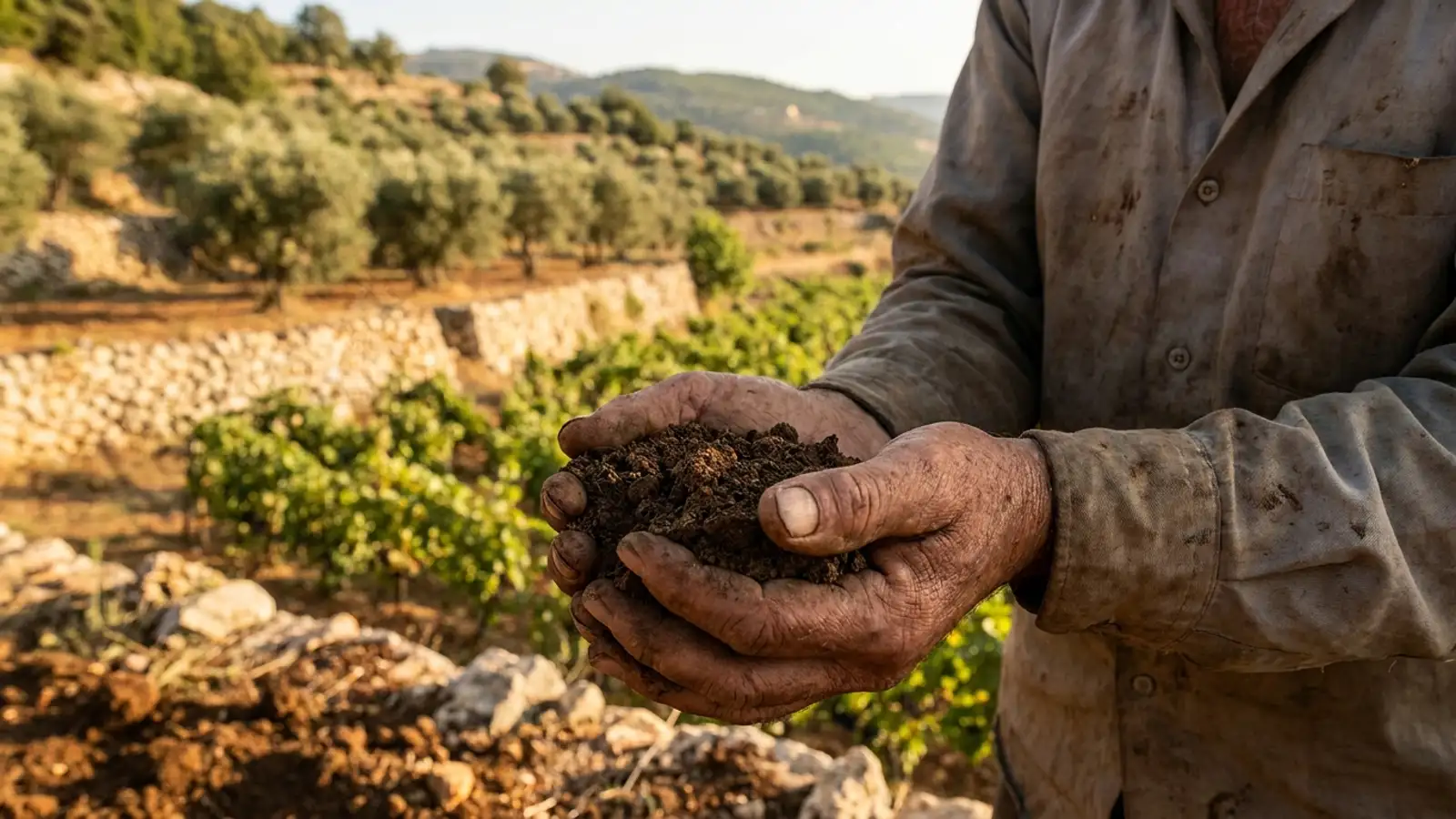
For six years the work was a whole farm operation in Lebanon's Chouf District: planting decisions, inputs, labour, treatment, harvest, true cost per unit, buyers, price. Conventional, high-technology and biodynamic methods ran side by side, not as an ideological position but because a working farm needs whichever one answers the season in front of it.

Running it end to end, from the ground to the shelf, surfaced something no study finds from the outside. The farm generates intelligence every single day, and almost none of it is ever captured in a form the farmer can use, own, or trade on.

"The farmer produces the intelligence and is the only one in the chain who never gets to keep it."

The Problem

Farmers hold the intelligence. Everyone else holds the data.

The daily record stays in a notebook or in someone's head. The buyer knows the market price; the farmer knows the cost and nothing else. Value is captured further down the chain, by the people who have the numbers.

01

No evidence to price with

Without a cost and yield record, the farmer negotiates on hope. The buyer negotiates on data.

02

No business model to build on

A farm cannot plan, borrow, or expand against intelligence it has never written down.

03

No national picture to govern with

Ministries plan a whole sector from surveys and estimates, because the ground truth was never collected.

The Framework

From the daily record to the retail shelf.

Five layers, built in the order a farm actually experiences them. Each one turns something the farm already knows into something it owns.

  1. 01 Operations The daily record: planting, inputs, labour, treatment, irrigation, harvest, and true cost per unit.
  2. 02 Produce Yield, quality, grading, timing and seasonality, recorded so a buyer can verify and a farmer can prove.
  3. 03 Market intelligence Demand, pricing, competing supply, and where the value actually sits along the chain.
  4. 04 Sales and route to market Buyers, contracts, margin and terms, negotiated from evidence rather than from need.
  5. 05 Retail How produce reaches a shelf, what that shelf earns, and what it says to plant next season.

Every layer stays the farm's own asset: intelligence the farmer can carry to a bank, a buyer, or a cooperative.

Practice

Conventional, high-technology and biodynamic, held as one continuum.

Most programmes make a farm choose a camp. Six years of running one taught the opposite. The methods answer different problems, and a farm that can move between them is more resilient than a farm defending a position. The framework records all three the same way, so the intelligence stays comparable whichever the farm is practising this season.

Conventional

Yield, rotation and cost discipline. The methods a farm already runs on, recorded properly for the first time.

High technology

Sensors, imagery and precision inputs. Instrumentation that earns its place by paying for itself.

Biodynamic

Soil life, timing and closed loops. The long-horizon practice that decides what the land is still worth in twenty years.

At National Scale

The same spine, built as systems architecture.

What works on one farm becomes a national capability only if someone builds the software layer underneath it. That is the second half of the work: registries, shared data standards, the platforms ministries and cooperatives operate, and the governance that settles who owns what.

01

Data standards

One way of recording a harvest, so a thousand farms produce a picture rather than a thousand spreadsheets.

02

Platform architecture

The systems a ministry, cooperative or programme actually runs, specified to be owned rather than rented.

03

Sovereignty and ownership

Who holds the data, where it is hosted, and what the farmer keeps. Decided at the start, in writing.

The Principle

Intelligence that elevates the people inside it.

Agricultural technology is usually sold on how many people it removes from the process. This framework is built on the opposite premise. The farmer is the source of the intelligence, and the system exists to raise their standing rather than to route around them. That principle comes from Harmonic Field, the movement and organisation where the digital, ecological and human threads are researched as one field.

Built to be deployed, not admired

Ministries

A national picture built from farms upward rather than from surveys downward.

Cooperatives

Shared intelligence across members, and the bargaining position real numbers create.

NGOs and programmes

Measured on what the farm still holds afterwards, not on what was distributed.

Agricultural businesses

Operational and market intelligence in one record, field through to shelf.

Common Questions

Frequently asked.

The Farmer Intelligence Framework is an end-to-end model for capturing the intelligence a farm produces every day and keeping it in the farmer's hands. It came out of six years running a whole farm business in Lebanon's Chouf District across conventional, high-technology and biodynamic practice. It spans five layers: daily operations, produce, market intelligence, sales and route to market, and retail.
The framework is built for agriculture ministries and public programmes, cooperatives and producer groups, NGOs and development programmes, and agricultural businesses. At national scale it is delivered as systems architecture: shared data standards, the platforms a ministry runs, and governance settling who owns the data.
Harmonic Field supplies the principle the framework is built on: technology should elevate the people inside a system rather than remove them. The farmer is the source of the intelligence, so the architecture raises their standing instead of routing around them.